A reference on the regulatory framework, construction approaches, and practical considerations for photovoltaic systems installed on farmland across Italian regions.
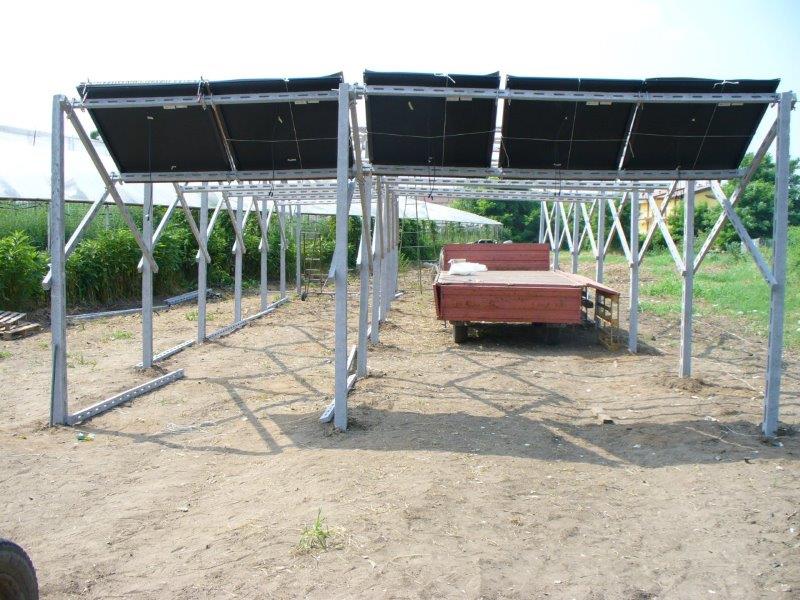
Agrivoltaic prototype under construction in Isola Della Scala, Verona, Italy (2008). Photo: Emilio Roggero / Wikimedia Commons, CC BY 4.0.
Topics
Three areas where agrivoltaic deployment in Italy raises practical questions: the legal and administrative environment, structural design, and agricultural land management.
Italy's national guidelines, regional authorisation procedures, and how Legislative Decree 199/2021 shapes agrivoltaic project approvals on farmland.
Read article →Elevated and tracking structures used in Italian agrivoltaic installations, clearance heights, foundation types, and how design choices affect continued farming operations.
Read article →Which crops have been tested under photovoltaic canopies in Italian conditions, what the observed yield data shows, and factors that influence shading tolerance.
Read article →Context
Italy's agricultural landscape — from the Po Valley grain fields to the hillside vineyards of Tuscany and the vegetable plots of Puglia — presents distinct conditions for co-locating photovoltaic generation with food production.
The country's national energy plan has set targets for renewable capacity that require using a significant portion of available land. Agrivoltaics has emerged as a way to address land use conflicts by combining solar generation with continuing agricultural activity on the same parcels.
This site collects reference information on how these systems work in the Italian context: the administrative procedures involved, the structural solutions used, and what is known about agricultural performance under partial shading.
Cardoncelli mushroom cultivation under agrivoltaic panels in Laterza, Taranto, Italy (2011). Photo: Emilio Roggero / Wikimedia Commons, CC BY 4.0.
Reference Points
Italy's national guidelines (CREA/GSE 2022) define an agrivoltaic system as one where agricultural activity continues on the land covered by the installation, with specific thresholds for minimum usable land area and requirements for ongoing crop production or livestock grazing. Ground-mounted solar arrays with no continuing agricultural use on the plot are classified differently for permitting purposes.
The information here covers photovoltaic systems on agricultural land in Italy. It does not cover rooftop installations, floating solar, or agrivoltaic developments in other countries except where comparative data is relevant. Content is drawn from publicly available regulatory documents, published research, and institutional guidance. Last updated: May 2026.
Contact
For questions about the content on this site, corrections, or general enquiries.
Fields marked with * are required. Submissions are not stored or forwarded.