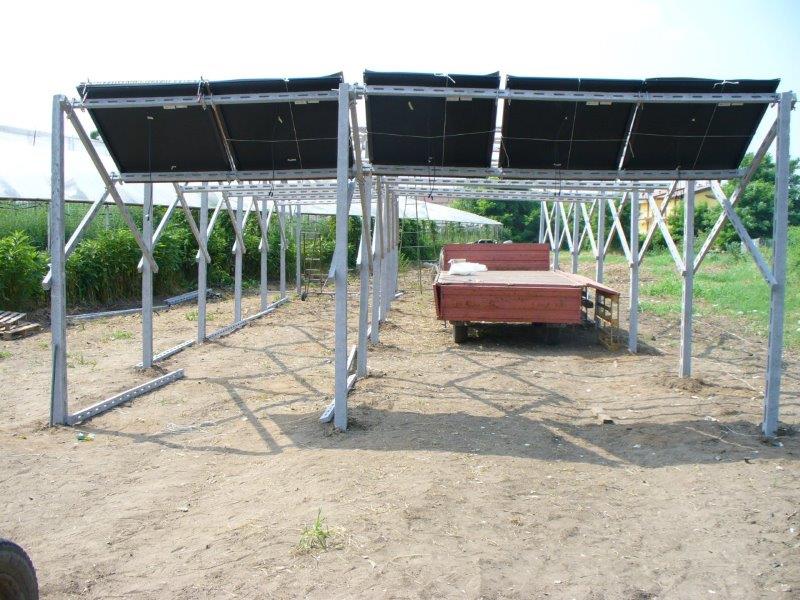
Agrivoltaic prototype under construction in Isola Della Scala, Verona (2008). Photo: Emilio Roggero / Wikimedia Commons, CC BY 4.0.
Legislative Decree 199/2021 and the PNRR Context
Italy's main legal basis for renewable energy development is Legislative Decree 199 of 8 November 2021, which transposed EU Directive 2018/2001 (the Renewable Energy Directive, or RED II) into national law. The decree introduced the concept of "agrivoltaic" as a distinct category of installation, separate from conventional ground-mounted solar on agricultural land.
Agrivoltaic projects were also included in Italy's National Recovery and Resilience Plan (PNRR), with a dedicated investment line targeting the southern regions where solar irradiance is high and agricultural land is more available. The inclusion of agrivoltaics in the PNRR created pressure to define the category precisely, because PNRR disbursements required demonstrable outcomes on both the energy and agricultural dimensions.
The GSE and CREA Guidelines (2022)
The most operationally significant document for project developers is the joint guidance issued in 2022 by the Gestore dei Servizi Energetici (GSE) and the Council for Agricultural Research and Economics Analysis (CREA). This guidance established the technical and administrative criteria that distinguish agrivoltaic installations from standard solar farms.
Key criteria in the 2022 guidelines
The guidelines set out minimum standards across several dimensions:
- Land use retention: At least 70% of the land beneath and between the solar arrays must remain available for agricultural use, measured as a proportion of the total project area.
- Crop continuity: Agricultural activity must be maintained throughout the operating life of the installation. The guidelines require documentation of ongoing production — abandoning the crop while retaining the panels would remove the project from the agrivoltaic category.
- Module height: Panels must be installed at a minimum clearance height sufficient to allow standard agricultural machinery to operate. The guidelines reference a minimum of 2.1 metres to the lower edge of the panels, though this varies with the type of farming activity.
- Monitoring: Projects above a defined capacity threshold must include monitoring instrumentation to track crop yields, water use, and soil conditions over time. This data feeds into a national database maintained by CREA.
The GSE/CREA guidance is not legislation — it is administrative guidance. However, in practice, the criteria it establishes are applied in Autorizzazione Unica (single authorisation) proceedings and in eligibility assessments for the Conto Energia and similar incentive mechanisms.
Authorisation Procedures
The authorisation route for an agrivoltaic installation depends on installed capacity and on whether the site is in a zone with specific landscape or environmental constraints.
| Capacity | Procedure | Responsible authority |
|---|---|---|
| Up to 1 MW | Procedura Abilitativa Semplificata (PAS) | Municipality |
| 1–10 MW | Procedura Abilitativa Semplificata or Autorizzazione Unica depending on regional rules | Province or Region |
| Above 10 MW | Autorizzazione Unica (single authorisation) | Regional authority |
The Autorizzazione Unica is a coordinated procedure that brings together the positions of multiple bodies — the municipality, the regional agricultural authority, environmental agencies, and heritage protection bodies where relevant — into a single approval process. Legislative Decree 199/2021 set a maximum duration of 90 days for the procedure, though in practice timelines vary.
Agricultural Land Classification and Restrictions
Italian planning law distinguishes between different classes of agricultural land, and not all classes are treated equally in agrivoltaic proceedings. The most productive agricultural soils — designated as "classe I" under national classification — face additional scrutiny. Some regions have introduced moratoria or specific restrictions on solar installations on the highest-quality agricultural land.
In the southern regions, where large areas of agricultural land have been identified as suitable for solar development, regional governments have introduced their own planning documents that overlay the national framework. Calabria, Puglia, and Sicilia have each issued regional energy plans that address the balance between renewable energy development and agricultural land protection.
Landscape and Heritage Constraints
A significant proportion of Italy's agricultural land is subject to landscape constraints under the Codice dei Beni Culturali e del Paesaggio (Legislative Decree 42/2004). Installations in constrained zones require a landscape compatibility assessment (autorizzazione paesaggistica), which adds a layer to the permitting process and can extend the timeline considerably.
Areas within a defined distance of archaeological sites, coastlines, or certain river corridors are subject to automatic constraints. The Ministry of Culture (MIC) participates in the authorisation procedure for installations in these areas.
Incentive Mechanisms
Agrivoltaic installations are eligible for the GSE's Conto Energia incentive through the Registro and Aste mechanisms, which allocate feed-in premiums through competitive tendering. The agrivoltaic category benefits from a tariff premium over standard ground-mounted solar installations, provided the project meets the GSE/CREA criteria and passes post-installation monitoring checks.
Projects under a certain capacity threshold can access simplified access to incentives through the GSE's online portal without participating in competitive tenders.
Outlook
The regulatory framework for agrivoltaics in Italy remains in development. Several delegated decrees provided for under Legislative Decree 199/2021 had not yet been finalised as of early 2026. Regional governments continue to develop their own guidance, and the interaction between national and regional rules is an ongoing source of procedural complexity.
The European Commission's recommendations on permitting acceleration for renewables have added pressure to reduce the duration of the Autorizzazione Unica procedure, particularly for projects in designated renewable acceleration zones (aree idonee).
References
- Legislative Decree 199/2021 of 8 November 2021, transposing EU Directive 2018/2001. Italian Official Gazette (Gazzetta Ufficiale) n. 285, 30 November 2021. gazzettaufficiale.it
- GSE/CREA, "Linee guida per l'agrivoltaico" (2022). Gestore dei Servizi Energetici. gse.it
- EU Directive 2018/2001 on the promotion of the use of energy from renewable sources. eur-lex.europa.eu
- Codice dei Beni Culturali e del Paesaggio, Legislative Decree 42/2004. normattiva.it